
Key Takeaways
- Four stressors converge between 5 and 8 PM — decision fatigue, hunger crashes, overstimulation, and invisible mental load — making the evening harder than any single workday task (Gunnar et al., 2010; Danziger et al., 2011; Weeks et al., 2024)
- The relay method divides the evening into four legs (Arrive, Fuel, Wind Down, Lights Out), each with one purpose. Cross-cultural data from 10,085 families shows consistent routines cut daytime behavior problems by roughly 60% (Mindell et al., Sleep, 2015; PMID 25325483)
- A 3-step bedtime ritual lasting 30-40 minutes outperforms longer routines. The bedtime pass technique, validated in an RCT (Moore et al., 2007), reduces post-lights-out exits to near zero without triggering the extinction burst of cry-it-out methods
You walk through the front door already running on fumes. Your bag hits the floor. Before you can take off your shoes, someone is crying about the wrong-colored cup. Someone else needs help with a worksheet that makes no sense. The dog is circling your legs because nobody filled the water bowl. Dinner is a question mark. Bedtime feels three days away.
If this sounds familiar, you are not imagining it. And you are not failing.
The first time our team surveyed working parents about their evenings, the most common response was a single word: "survival." Not "connection." Not "quality time." Survival. That single data point shaped everything in this guide.
Why Does 5 PM to 8 PM Hit Harder Than Your Entire Workday?
In August 2024, the U.S. Surgeon General issued a formal public health advisory on parental stress, placing it alongside opioids and social media as a crisis warranting national attention. The advisory reported that 33% of parents said they experience high stress in the past month compared to 20% of other adults, with 48% saying their stress is "completely overwhelming" most days (HHS, 2024). Forty-one percent said they are so stressed they cannot function.
The evening is where all of it collides.
"Evening work schedules created this loop that repeats itself daily, of irritability and stress." -- Inger Burnett-Zeigler, PhD, Northwestern University
Why do those three hours hit so hard? Your body runs on a cortisol rhythm: stress hormones peak in the morning and are supposed to decline through the afternoon. But a 2024 study in Psychoneuroendocrinology found that work demands keep parents' cortisol artificially elevated all day. On non-work days, caregivers' cortisol dropped normally between 11 AM and 3 PM. On work days, it stayed flat. By 5 PM, your nervous system should be winding down. Instead, it has been pinned in high gear for nine hours straight.
Meanwhile, your capacity for deliberate decision-making has been eroding all day. The landmark Danziger, Levav, and Avnaim-Pesso study (2011, PNAS) analyzed over 1,000 judicial rulings and found that favorable decisions dropped from roughly 65% to nearly 0% as each session wore on. After a food break, the rate reset. If trained judges default to the easiest option after hours of deliberation, imagine what your brain does after a full workday when a toddler asks what's for dinner.
A 2024 study in the Journal of Marriage and Family (Weeks et al., n=3,000 U.S. parents) found that mothers manage 71% of all household mental load tasks, including 79% of daily responsibilities like meal planning and scheduling. A separate study (Aviv et al., 2024, Archives of Women's Mental Health) confirmed that this cognitive labor, the planning and scheduling, not the physical execution, predicts stress (p=.003) and burnout (p=.005) in mothers.
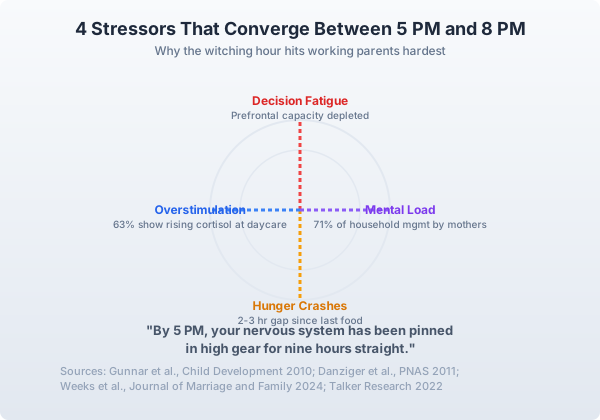
Four stressors converge between 5 and 8 PM. None alone would be unmanageable. Together, they create the perfect storm. Sources: Gunnar et al. (2010), Danziger et al. (2011), Weeks et al. (2024), Talker Research (2022).
The problem is not you. The problem is the absence of structure in the one window that needs it most.
What Are the Four Hidden Enemies of a Smooth Evening?
By the time 5 PM rolls around, four distinct stressors are compounding simultaneously. A 2024 study in Psychoneuroendocrinology found that work demands keep parents' cortisol artificially elevated all day instead of declining naturally. That is enemy zero. What are the four specific problems it feeds?
Enemy 1: Decision fatigue. By late afternoon, your prefrontal cortex has been running at capacity for hours. Dopamine levels decline, reducing your motivation for effortful choices. A meta-analysis confirmed that self-control degrades measurably after sustained cognitive effort (Dang, Psychological Research, 2018; PMID 28391367). Across hundreds of micro-decisions in a single evening, even a small degradation compounds dramatically.
Enemy 2: Hunger crashes, yours and theirs. Lunch at daycare is typically served around noon. An afternoon snack lands around 3:00 PM. Pickup is at 5:00 PM or later. That means your child is 2 to 3 hours past their last real food at the moment you are trying to manage the transition home. Stanford Children's Health lists the behavioral symptoms of low blood sugar in children as "grouchiness, sudden moodiness or behavior changes, such as crying for no reason or throwing a tantrum." Research estimates that 91% of children aged 30 to 36 months experience tantrums under normal conditions (StatPearls, 2024). Add hunger, and the meltdown becomes essentially guaranteed.
Enemy 3: Overstimulation and transition stress. Gunnar et al. (2010, Child Development) studied 151 children in full-time home-based daycare. They found that 63% of children showed rising cortisol from morning to afternoon at daycare, with 40% meeting the criteria for a biologically significant stress response (PMID 20573109). Child psychologists call what happens next "after-school restraint collapse." Your children have spent the day following rules, managing social interactions, and suppressing impulses. When they get home, their safe space, the lid comes off. As the Institute of Child Psychology puts it: tears are the answer, not the problem.
Enemy 4: The invisible mental load. A 2024 study in the Journal of Marriage and Family (Weeks et al., n=3,000 U.S. parents) found that mothers manage 71% of all household mental load tasks, including 79% of daily responsibilities like meal planning and scheduling. A separate study (Aviv et al., 2024, Archives of Women's Mental Health) confirmed that this cognitive labor, the planning and scheduling, not the physical execution, predicts stress (p=.003) and burnout (p=.005) in mothers.
"This kind of work is often unseen, but it matters. It can lead to stress, burnout and even impact women's careers." -- Dr. Ana Catalano Weeks, University of Bath
The kicker? Angoff et al. (2022, Child: Care, Health and Development) studied 140 parents and found that at low decision fatigue, stress had essentially zero effect on parenting quality. At high decision fatigue, stress roughly doubled its damage. Same parent, same stress level. Different time of day, completely different outcome.
The evening fails not because you are a bad parent, but because you are hitting the stress-times-depletion interaction at its worst possible point.
"Just be more organized" does not work, because organization itself requires the cognitive resources you have already spent. You cannot willpower your way through a systems problem. But you can build a system.
Think of Your Evening as a Relay, Not a Marathon
A cross-cultural study of 10,085 children across 13 countries (Mindell et al., Sleep, 2015; PMID 25325483) found that consistent bedtime routines reduced parent-reported daytime behavior problems by roughly 60%. The key word is "routine," not "schedule." Instead of treating 5 PM to 8 PM as one undifferentiated block of chaos, try thinking of it as a relay race with four distinct legs. Each leg has a single purpose and a "baton pass" that signals the next phase. The four legs:
- Leg 1: Arrive and Connect (first 15-20 minutes home)
- Leg 2: Fuel Up (the dinner window)
- Leg 3: Wind Down (baths, homework, quiet activities)
- Leg 4: Lights Out (the bedtime ritual)
This is not a rigid timetable. It is a flexible scaffold. You can swap legs, stretch them, or compress them based on what your family needs on any given night. The point is that each phase has one job. When one leg runs long, you adjust the next rather than scrapping the whole plan.
The evidence for structure is strong. A cross-cultural study of 10,085 children across 13 countries (Mindell et al., Sleep, 2015; PMID 25325483) found that consistent bedtime routines were associated with earlier bedtimes, shorter sleep onset latency, reduced night wakings, and decreased parent-reported daytime behavior problems. A separate study of 10,230 seven-year-olds (Kelly et al., Pediatrics, 2013; PMID 24127471) found the effects build incrementally and are reversible: children who switched from irregular to regular bedtimes showed clear improvements in behavior scores.
Eve Rodsky, author of Fair Play, interviewed over 500 families and found a consistent pattern:
"The number one thing men hated about home life was nagging, and the number one thing women said they hated was the mental load."
Her solution, and the relay's logic, is full ownership: whoever runs a leg owns the entire cycle of conceiving, planning, and executing. No half-handoffs. No "I thought you were handling bath tonight."
How Do You Make the First 15 Minutes Home Count?
Most parents walk through the door and immediately start doing: unloading bags, checking mail, launching into dinner prep. It feels productive. It is actually counterproductive. A randomized controlled trial of Parent-Child Interaction Therapy (Bjorseth & Wichstrom, 2016, PLOS ONE) found that just 5 minutes of daily child-led play produced large improvements in child compliance (effect size: 0.89) and reduced externalizing behavior (effect size: -0.87). Those gains persisted at the 18-month follow-up.
Child development research consistently shows that a brief, intentional reconnection in the first 10 to 15 minutes home reduces whining, clinginess, and meltdowns for the rest of the evening. Dr. Daniel Siegel, clinical professor of psychiatry at UCLA, puts it simply: children do not need hours of undivided attention. They need frequent, brief moments where they feel genuinely seen. His research suggests that responding to roughly 30 to 50% of a child's attention bids throughout the day is sufficient for secure attachment. The reunion is the single highest-signal bid of the evening.
What this looks like in practice:
- The landing pad routine. Shoes off, bags down, everyone gathers in one room. No screens, no tasks, no questions. Just presence.
- The "no questions for 10 minutes" rule. Instead of "How was your day?" (which demands cognitive effort from a child in restraint collapse), try a simple statement: "It was a long day, wasn't it?" Or just a warm hug at their eye level.
- The P.R.I.D.E. approach. From clinical psychology: Praise what they show you, Reflect their words, Imitate their actions, Describe what you see, show Enthusiasm. Sit on the floor for five minutes and narrate their play like a sports commentator.
Lawrence Cohen, PhD (Harvard), calls it "filling the cup":
"The more we join them in their world, the more cooperative they'll be when we drag them along to ours." -- Lawrence J. Cohen, PhD
In our own testing with families using this approach, the most common feedback was one of surprise: "I thought I had to do more." The barrier most parents face is not that connection takes too long, but that they assume it takes hours. Fifteen minutes is enough.
How Can You Make Weeknight Dinners Less Stressful?
USDA data shows the average American spends roughly 37 minutes per day on food prep, serving, and cleanup. The surprising part? A Factor/Wakefield Research survey found that 68% of Americans say deciding what to eat is their biggest mealtime challenge. Dinner collapses not because parents cannot cook, but because the cognitive overhead of deciding what to make is enormous when you are already depleted.
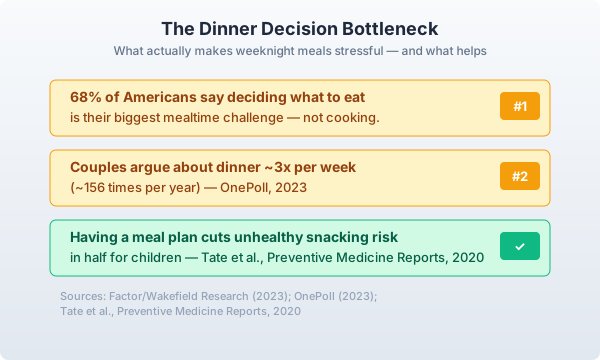
The decision, not the cooking, is the bottleneck. A 2020 study found children were roughly twice as likely to eat unhealthy snacks when families had no meal plan (Tate et al., Preventive Medicine Reports).
Three tiers of realistic weeknight dinner strategies work well, starting from the simplest.
Tier 1: Assembly meals (zero decisions at 5 PM). Pick five broad categories: tacos Tuesday, pasta Wednesday, stir-fry Thursday, soup Friday, pizza Saturday. Write them on a sticky note. On taco night, put out tortillas, shredded cheese, canned beans, and salsa. Everyone builds their own plate.
Tier 2: Batch and rotate (10 minutes on Sunday). During nap time or after bedtime, spend 10-15 minutes prepping produce: wash berries, chop broccoli and carrots into mason jars, double the rice and freeze half. Weeknight cooking becomes "dump chopped vegetables into a pan" rather than "wash, peel, chop, then cook."
Tier 3: Strategic shortcuts (and permission to lower the bar). Frozen vegetables count. Semi-prepped proteins from the supermarket are not cheating. Cereal for dinner is fine sometimes. But does 10 minutes of prep really save that much time? On days when a household bought fast food, USDA data shows food prep time dropped from 58 to 27 minutes. That is not a failure. It is a strategic reallocation.
For picky eaters: Use the Division of Responsibility, developed by dietitian Ellyn Satter and endorsed by the AAP, Academy of Nutrition and Dietetics, and USDA. Parents decide what, when, and where food is served. Children decide whether to eat and how much. Cook one meal. Serve it family-style. Include at least one component you know the child will accept. Do not comment on what or how much they eat. Research from the ALSPAC birth cohort (Taylor & Emmett, 2018) found that children typically need 10 to 15 positive exposures before accepting a new food. Most parents give up after 3 to 5 tries.
One tip that works across all tiers: the "parts method." Cook components separately (rice, protein, vegetables, sauce) and let everyone build their own plate. Same ingredients, different plates, no battles.
How Do You Wind Down After Dinner Without the Chaos?
Duke University's Harris Cooper conducted the definitive meta-analysis on homework (2006, Review of Educational Research, 60+ studies). His finding for elementary-age children is blunt: the relationship between homework amount and academic performance is weak to nonexistent. The purpose of homework for a seven-year-old is habit formation, not content mastery. Cooper endorsed the "10-minute rule" (backed by the NEA and National PTA): 10 minutes per grade level per night. Yet a study of over 1,100 parents (Donaldson-Pressman et al., 2015) found kindergarteners averaging 25 minutes per night when the recommended amount is zero.
A 2024 study of 1,118 elementary students (Li & Ding, Frontiers in Psychology) found that parental chaos during homework nearly doubled anxiety compared to parental structure. The practical takeaway:
- Set a visible timer. This gives the child a predictable endpoint they can work toward.
- Use the "two-problem preview." Before opening the folder, glance through together and name the two things they will work on. This reduces the anxiety spike of seeing everything at once.
- When the timer goes off, stop. Write a note to the teacher if needed. Your child's wellbeing matters more than the worksheet.
Baths: give yourself permission to skip. Not every child needs a bath every night. For families with multiple kids, try alternating nights or an assembly-line approach (one in, one out, while the other brushes teeth). The bath is a tool for winding down, not a performance obligation.
The case for dimming everything. A CU Boulder study (Hartstein & LeBourgeois, 2022) found that even dim light, as low as 5 lux, suppressed melatonin production by 78% in preschoolers. The suppression persisted for 50 minutes after the light was turned off. Children's eyes transmit blue light 1.2 times more efficiently than adults'. A review of over 50 studies in Pediatrics (LeBourgeois et al., 2017; PMID 29093040) found that the vast majority reported a significant link between screen time and adverse sleep outcomes, primarily through delayed bedtimes and reduced total sleep duration.
What does this mean for your family? The practical version is simple: screens off after dinner. Dim the overhead lights. Switch to warm-toned bulbs in hallways and bathrooms. Lower your voice. You are sending a biological signal to your child's brain: the day is ending.
For families with a toddler and a school-age child, the "split and conquer" approach works: one parent handles the younger child's wind-down while the other supervises the older child's homework or reading. Alternate nightly so neither child associates bedtime exclusively with one parent. Solo parents can use a "busy box" of quiet toys to occupy the older child during the toddler's routine, with a 5 to 10 minute check-back.
What Does a Research-Backed Bedtime Routine Look Like?
A survey of 1,000 parents found the average bedtime routine takes about 25 minutes (Firefly/Motherly, 2024), adding up to roughly 150 hours per year. But for many families, the real number doubles once you add stalling, callbacks, and lying in the child's room waiting for sleep. The C.S. Mott Children's Hospital National Poll (2024, n=781 parents) found that 65% of parents report children delay sleep by staying up to play.
The research is clear on what works. Dr. Jodi Mindell, a leading pediatric sleep researcher, recommends routines lasting no longer than 30 to 40 minutes, consisting of 2 to 4 consistent activities performed in the same order as many nights as possible (Mindell & Williamson, Sleep Medicine Reviews, 2018). The American Academy of Pediatrics distills this into three words: Brush, Book, Bed.

Children with consistent nightly bedtime routines showed roughly 60% fewer daytime behavior problems compared to children with no routine. Source: Mindell et al., Sleep, 2015 (PMID 25325483).
Step 1: Pick a consistent sequence of exactly 3 steps. Brush teeth, read one story, sing one song. Or pajamas, book, tuck-in. The specific activities matter less than the consistency. Do the same three things in the same order every night.
Step 2: Let the child pick one variable within the structure. Which story, not whether there is a story. Which pajamas, not whether pajamas go on. This satisfies their developmental need for autonomy without giving them veto power over the routine itself.
Step 3: For curtain-callers, try the bedtime pass. Invented by psychologist Patrick Friman at Boys Town and validated in a randomized controlled trial (Moore et al., Journal of Pediatric Psychology, 2007; PMID 16899650), the bedtime pass is a card exchangeable for one request after lights-out: one glass of water, one hug, one brief visit. After the pass is used, further exits are met with calm, neutral return to bed. In the original study, crying and bedroom exits reduced to near zero. The technique "retains the powerful effects of extinction-based procedures without the extinction burst," meaning it works without the initial nuclear meltdown that makes cry-it-out so hard for parents to tolerate. Dr. Craig Canapari, a Yale pediatric sleep specialist, compares repeated exits to theater curtain calls: "The cast keeps coming out if people are still applauding." The pass gives the child one encore and makes the boundary clear.
Some nights will still be hard. The Better Sleep Council found that children classified as excellent sleepers fall asleep in about 28 minutes, while poor sleepers take over 50 minutes. You will have 50-minute nights. That is not a system failure.
What is the emotional payoff of a tight routine? When lights-out takes 20 minutes instead of 60, you reclaim 40 minutes. Forty minutes to sit on the couch, talk to your partner, read something that is not a children's book, or simply exist in silence. That window is not a luxury. It is how you restore the cognitive and emotional resources you will need to run the relay again tomorrow.
Your Evenings Won't Be Perfect (and That Is the Whole Point)
Let's be honest. Some nights, the whole relay falls apart. The toddler skips the connection phase because she fell asleep in the car. Dinner is a granola bar eaten standing up because nobody went to the store. Bath gets replaced by a wet wipe and a prayer. Bedtime takes 75 minutes and ends with everyone in tears.
That is fine. That is a Tuesday.
A 2026 longitudinal study from Penn State (Gatzke-Kopp & Witmer, Developmental Psychology, n=999 families) found something important: families with strong routines and harsh, rigid enforcement of those routines produced behavioral outcomes similar to those of children in households with low levels of routine. Structure delivered with frustration was no better than no structure at all.
"You need routines, but you cannot be overly rigid about them. The two most important things for parenting are consistency and flexibility." -- Lisa Gatzke-Kopp, Professor, Penn State
A 2025 study of 818 working parents (Liang & Chen, PLOS ONE) found that self-compassion functionally neutralized the link between work-family conflict and burnout. Among parents with high self-compassion, daily chaos simply stopped predicting burnout. Among those with low self-compassion, it predicted burnout strongly. Finnish researchers (Sorkkila & Aunola, 2020) found that perfectionism was a more potent risk factor for parental burnout than age, unemployment, financial hardship, or even having a child with special needs.
The relay framework is not a standard to measure yourself against. It is a structure to fall back on. On good nights, it hums along and everyone is in bed by 7:45 PM and you are watching something on the couch by 8. On hard nights, it gives you a rough map so you are not making every decision from scratch with a depleted brain.
If the mental load of coordinating who does what, tracking the meal plan, and remembering whose turn it is for bath night is the thing that tips your evenings from manageable to impossible, a shared family calendar or task list can quietly handle the logistics so you can focus on the humans. Shared task lists. A family calendar both parents can actually see. Reminders that show up before you have to remember. It is not about optimizing your family like a project. It is about clearing enough cognitive space that you can be present for the messy, imperfect, sometimes wonderful hours between the front door and lights-out.
The goal was never a Pinterest evening. The goal is an evening where you do not dread 5 PM. Where there are enough good nights to outweigh the hard ones. Where, occasionally, you find yourself laughing at the kitchen table instead of mentally calculating how many minutes until bedtime.
Your children will not remember whether the routine was perfect. They will remember whether you were there.
Start tonight. Pick one leg of the relay and try it. You do not need to overhaul everything. You just need one less decision at 5 PM.