
Key Takeaways
- Parents carry 30.4 hours per week of invisible mental load, equivalent to a part-time job worth $60,000 annually (Harris Poll/Skylight, 2025)
- Structured handoff protocols adapted from healthcare cut errors by 23% and can transform how shift parents coordinate (NEJM, 2014)
- Children with consistent bedtime routines show dramatically fewer behavioral problems: 9.1% vs 22.9% (PMC, 2015)
- Thriving couples invest just 6 intentional hours per week in micro-connection, even with staggered schedules (Gottman Institute, 2024)
You know this morning. The alarm goes off at 5:47 because you set it one minute earlier than necessary, as if that extra minute buys you something. You roll out of bed, step around the toy on the floor, and start the coffee maker before your brain is fully online. Your partner is still asleep. As you leave, you mumble something about a pediatric appointment at 3pm, leftover pasta in the fridge, and the fact that your daughter's school photo order is due today. Or maybe you just thought you said all that. You are not sure.
At 4pm you will get a text: "Wait, what pediatric appointment?"
When Reshma Saujani, CEO of Moms First, asked parents on social media to describe split shift parenting, one word dominated: "exhausting." One parent started work at 4am so their partner could cover the afternoon shift. Another mother said she "finally broke from lack of sleep," and even after adjusting their schedules, the family still "had no days together for family time."
A point worth emphasizing: this is not a communication failure. It is a systems gap. And it affects a majority of families in the country.
Two-thirds of married families with children are now dual-earner households. Parents spend an average of 30.4 hours per week on scheduling and planning tasks alone. If compensated, that invisible labor would be worth $60,000 per year. More than half of parents say they spend more time on the logistical aspects of parenting than the joyful ones.
The real costs are not abstract. Missed medication doses. Double-booked activities. A child whose tough day at school goes unmentioned because the incoming parent never heard about it. And underneath it all, the slow erosion of feeling like you and your partner are on the same team.
This article treats the daily parent-to-parent handoff as a solvable logistics problem. Not a willpower problem.
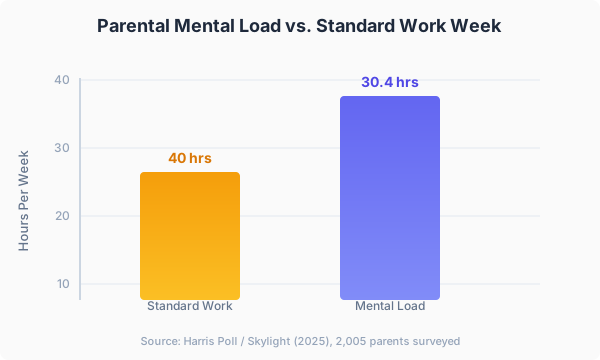
Parents spend 30.4 hours weekly on mental load, nearly matching a standard work week. Source: Harris Poll / Skylight (2025).
Why Text Threads and Sticky Notes Are Failing You
According to the Pew Research Center, 78% of mothers say they handle most of their children's scheduling, making it the most unbalanced parenting task ever measured (Pew, 2023). The root cause is not forgetfulness. It is what researchers call information asymmetry: the parent on duty accumulates context throughout the day that never fully transfers during the handoff. Three layers of context get lost: cognitive (what was planned, what changed), emotional (your daughter is anxious about tomorrow's spelling test), and logistical (the soccer coach texted about a time change).
A 2025 study in the Journal of Marriage and Family found that mothers handle 71% of household tasks requiring mental effort. The researchers distinguished between "core" cognitive work, which is daily and always-on, and "episodic" tasks like home repairs that happen intermittently. Mothers disproportionately carry the core load. Even couples who identify as gender-egalitarian show this gap. The Pew Research Center found that 78% of mothers say they do more when it comes to managing their children's schedules, making this the most unbalanced parenting task ever measured.
Your text thread with your partner is also where you share memes, grocery requests, and "running 10 min late." Somewhere in that scroll is the message about refilling your kid's allergy medication. Good luck finding it at 7pm.
Citation Capsule: A 2025 study in the Journal of Marriage and Family found that mothers handle 71% of household tasks requiring mental effort, with the gap persisting even among couples who identify as gender-egalitarian (Wiley, 2025). Pew Research confirms 78% of mothers manage children's schedules, the most unbalanced parenting task measured (Pew, 2023).
The fix is not another messaging channel. It is a structured, persistent coordination layer that captures information from fragmented sources, keeps it accessible, and structures it for the handoff. What families need is a system, not a thread.
The Handoff Protocol: Building Your Family's Daily Briefing
Consider this: in hospitals, 70% of serious errors trace back to poor shift-to-shift communication. When hospitals implemented the I-PASS structured handoff framework, medical errors dropped 23% and preventable adverse events dropped 30%. Your family is not an ICU. But the principle holds: structured information transfer reduces mistakes at every handoff point.
Citation Capsule: In hospitals, 70% of serious errors trace back to poor shift-to-shift communication (American Nurse, 2024). Implementing the I-PASS handoff framework cut medical errors by 23% and preventable adverse events by 30% (NEJM, 2014). A structured approach to information transfer works across domains.
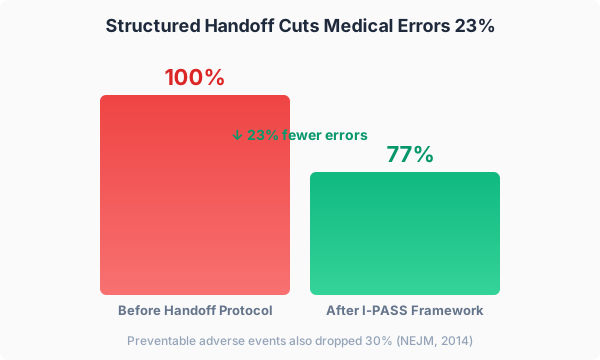
Structured handoff protocols cut medical errors 23% and adverse events 30%. Source: NEJM (2014).
Pillar 1: A Shared Calendar
Pick one calendar. Put everything on it: work schedules, kids' appointments, commitments. Color-code by family member. Setup takes less than 10 minutes. The hard part is not the technology, it is the habit.
The most important rule: both parents must update the calendar. If only one parent adds events, you have recreated the mental load problem inside the tool.
Pillar 2: Structured Handoff Notes
You already do this when you leave your kids with a babysitter: what they ate, how they are feeling, what the bedtime routine is. Then your partner takes over at 6pm and you tell them... "kids are fine, dinner's in the fridge."
A good handoff note takes two minutes and covers four things: (1) what happened, (2) what is coming up, (3) how each child is doing, and (4) any open items needing attention.
Bad handoff: "Kids fine. Bedtime 8pm."
Good handoff: "Emma struggled with math homework, it is on the kitchen table. Liam skipped afternoon snack, so he will be hungry early. Soccer bag is ready for tomorrow. The doctor called about Emma's rash, wants Thursday at 3pm. Someone needs to confirm. Emma seemed a bit off after school."
If typing feels like too much, record a 90-second voice memo while you are still on duty. Less friction than text, preserves tone, and can be listened to at the other parent's convenience.
Pillar 3: A Continuous Task List
"Call the dentist." "Sign the permission slip." "Order birthday party supplies." These tasks live in someone's head until they are done or forgotten.
A shared task list, even a shared Apple Note or a whiteboard on the fridge, makes them visible to both parents. Research finds that tensions stem from a lack of clarity, not a lack of fairness. Couples with shared task systems reported that "life felt fairer and less lonely."
The three pillars map to the three components of mental load that researchers have identified: the calendar externalizes anticipation, the handoff note transfers monitoring, and the task list distributes decision-making.
Digital Tools That Actually Help (Not Just Another App to Check)
You have probably downloaded and abandoned at least two family apps already. You are not alone. 25% of users abandon an app after a single session. By day 30, only about 5% are still using it.
The biggest predictor of whether a family app survives? Whether the second parent actually uses it. If it becomes a one-person operation, it amplifies the mental load instead of distributing it.
What actually works: low friction to update (voice and photo input beat manual forms), shared visibility without requiring both parents to open the app simultaneously, smart patterns that reduce data entry, and integration with tools you already use.
The landscape breaks into three tiers. Pure calendar sharing (Google Calendar, Apple Calendar, TimeTree) is free and familiar, but a calendar entry for "Soccer at 3pm" does not say who is driving or whether the shin guards are in the bag. Dedicated family apps (Cozi, Homsy, OurHome) are purpose-built, but the second-parent adoption problem is real. AI-assisted coordination tools reduce manual input by parsing school emails, extracting events from photos, and proactively surfacing schedule conflicts. Apps with embedded AI achieve nearly double the 30-day retention rate of traditional apps, because the tool does the work for you instead of just organizing your input.
Citation Capsule: 25% of users abandon a family app after a single session, and only 5% remain after 30 days (Amra & Elma, 2025). The strongest predictor of long-term use is whether both parents actively engage with the tool.
A practical guideline: more than two apps creates tool fatigue. Pick one calendar tool and one coordination tool. The best app is the one your family will actually use.
Protecting the Kids: Care Continuity Through Shift Changes
A 2024 systematic review in the Journal of Family Theory and Review found that consistent routines in early childhood predict better cognitive ability, stronger self-regulation, and improved school readiness (Wiley, 2024). This is the core finding that matters for shift parents: the critical variable is not which parent performs the routine. It is whether the routine stays consistent regardless of who is on duty.
Attachment research confirms: children can form secure bonds with multiple caregivers, as long as those caregivers are consistent and predictable. The risk is not in having two caregivers. It is in having two caregivers who operate differently.
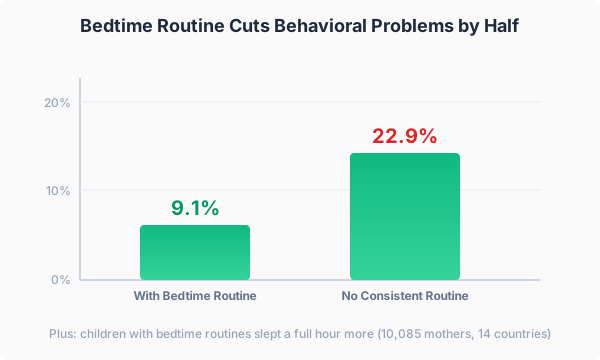
Consistent bedtime routines cut behavioral problems by more than half. Source: PMC / Mindell et al. (2015).
Two anchor routines that matter most
Bedtime. A study of 10,085 mothers across 14 countries found that children with a regular bedtime routine slept a full hour more and showed dramatically fewer behavioral problems (9.1% vs. 22.9%). The specific activities matter less than the sequence. Bath, book, song, executed the same way by different parents, provides the same developmental benefit. Improvements appeared within just three nights.
Mealtimes. Children who have regular family meals are 12% less likely to become obese and report better grades and lower anxiety levels. The menu matters less than the ritual: family sits together, no screens, conversation happens.
Both parents following the same steps for these two routines gives your child 7 days out of 7 of consistency, even on split shifts.
Citation Capsule: A study of 10,085 mothers across 14 countries found that children with consistent bedtime routines slept a full hour more and showed 9.1% behavioral problems vs. 22.9% without routines (PMC/Mindell, 2015). The specific activities matter less than the sequence. Improvements appeared within just three nights.
One more thing. The handoff note from the previous section is not just a parental convenience. It is a care continuity tool. If your child had a tough day and the incoming parent does not know, they might interpret anxious clinginess as misbehavior. Sharing emotional context lets the next parent meet the child where they are, not starting from zero.
The Relationship Layer: From Co-Managers Back to Partners
Harriet Presser's landmark study found that among parents married less than five years with children, working fixed night shifts made divorce six times more likely and three times more likely for mothers on night shifts (PMC, 2000). The mechanism surprised researchers: it was not exhaustion driving the split. It was reduced shared time, fewer shared meals, and a less active social life as a couple.
One couple captured it perfectly in a Gottman Institute interview: "We are excellent co-parents and roommates. We do not argue. We just... do not really see each other anymore."
Clinicians call this Roommate Syndrome. Every conversation gets reduced to logistics. You stop talking about feelings, dreams, or what is happening in your inner world.
The counterintuitive finding: researchers expected exhaustion to explain the link. It did not. The real mechanism is simpler: reduced shared time, fewer shared meals, a less active social life as a couple. It is not that you are too tired to connect. It is that you never have the window.
Better systems create more space for connection. When logistics are handled by a shared system, those precious few minutes of overlap can be about something other than task delegation.
Micro-rituals for staggered schedules
40 years of Gottman research found that thriving couples invest only six intentional hours per week in micro-connection. Adapt that for your staggered schedule with these micro-rituals:
- The 2-minute "how are YOU" check-in. Not "how are the kids." Just: how are you? What is on your mind? Two minutes. Every handoff.
- The 6-second kiss. Not a peck. Produces oxytocin and reminds you both that you are partners, not just co-managers.
- A weekly 15-minute "State of Us." Start with appreciation. Discuss one concern. End with what is coming up.
- Asynchronous voice notes of "my shift highlight." A 30-second note about something funny the kids did or something on your mind. Happy couples turn toward each other's bids 86% of the time. A voice note is a bid.
- Time-limited logistics talk. Set a timer for the "business talk" so it does not bleed into connection time.
Citation Capsule: Harriet Presser's landmark study found that parents with young children working fixed night shifts were six times more likely to divorce, driven not by exhaustion but by reduced shared time (PMC/Presser, 2000). Gottman research shows that 6 intentional hours per week of micro-connection sustain relationship quality despite staggered schedules.
When a shared system absorbs even a portion of the cognitive labor burden that falls disproportionately on mothers, it frees up mental bandwidth for the rituals that keep the relationship alive. You cannot do a 2-minute emotional check-in if your brain is processing tomorrow's logistics.
Your First Week: A Step-by-Step Starter Plan
Psychology research shows that framing new habits as experiments rather than permanent overhauls dramatically improves adoption by bypassing the brain's fault-detection system (Psychology Today, 2024). Treat this as a one-week experiment, not a lifetime commitment.
Days 1-2: Set up your shared calendar. This takes 10 minutes. Create a "Family" calendar, share it with your partner, color-code by family member. Add just two things: both parents' work schedules and the kids' fixed weekly commitments. Keep your old text habits alongside for now.
Days 3-4: Try a structured handoff. Pick one shift change. Record a 90-second voice memo covering what happened, what is coming up, how each child is doing, and any open items. Send it before the other parent takes over. Then watch: does the incoming parent ask fewer questions?
Days 5-7: Add a shared task list. A shared Apple Note, Google Keep note, or whiteboard on the fridge. Add 3-5 recurring tasks that always slip through. Each task has an owner for the week.
Day 7: The 10-minute check-in. Ten minutes of Sunday planning prevents 90% of schedule surprises. Look at the calendar together. Review the task list. Ask: what worked? What should we adjust?
Kids need 10 to 15 repetitions before a routine feels normal. Adults need about 21 days. Your first week is planting seeds, not expecting a finished garden. And if the Sunday check-in gets skipped because someone fell asleep on the couch? That is fine. It is data. Adjust and try again.
You Are Already Doing the Hard Part
Split shift parenting is the hardest version of modern parenting. You are parenting solo on a rotating basis, coordinating schedules that barely overlap, and trying to maintain a relationship with someone you sometimes see for 20 minutes a day.
A shared calendar, a 90-second voice memo, and a whiteboard on the fridge will not solve the childcare crisis or give you more hours in the day. But they can close the gap between what you know and what your partner knows. They can transform the 6am whispered handoff from a game of telephone into something you can both rely on.
You are already doing the hardest version of parenting. Wanting to make it smoother is not a sign that something is broken. It is a sign that you are building something that lasts.
Frequently Asked Questions
What is split shift parenting and why is it becoming more common? Split shift parenting staggers two parents' work schedules so one is always home with the kids. It is growing because childcare costs now consume 20% of household income, nearly triple the 7% affordability benchmark. A 2026 University of Wisconsin study confirmed dual-provider parents with young children are more likely to work desynchronized hours.
How many hours do parents spend on mental load tasks? Parents spend an average of 30.4 hours per week on invisible planning and coordination. If compensated at average wages, this labor would be worth roughly $60,000 per year. Mothers handle 71% of household tasks requiring mental effort.
Does split shift parenting negatively affect children? Not when routines stay consistent. A systematic review found consistent routines in early childhood predict better cognitive ability and self-regulation. Children with regular bedtime routines slept a full hour more and showed 9.1% vs 22.9% behavioral problems.
What is a parent handoff protocol? A structured handoff transfers information between parents during shift changes. It has three pillars: a shared calendar, structured notes covering what happened and what is coming up, and a shared task list. Healthcare adapted this same approach to cut errors by 23%.
What tools help split shift families? Pick one free calendar tool (Google Calendar, Apple Calendar) and one coordination tool. AI-assisted tools reduce manual data entry. The best app is the one both parents will actually use.