

Key Takeaways
- 81% of working parents report a smaller childcare village than prior generations (Bright Horizons / The Harris Poll, 2026), while 77% believe raising children requires a village.
- 38% of parents feel they have no one to support them (Ohio State University), yet 79% say they would value a way to connect with other parents.
- U.S. Surgeon General (2024) classified parental stress as a public health crisis: 65% of parents report loneliness and 48% experience overwhelming stress most days.
- Four proven steps -- map your hidden network, set up a swap system, build shared communication, and agree on ground rules -- can close the village gap in weeks.
You open your calendar, realize summer starts in six weeks, and see zero coverage. Camp waitlists are full. Your mother-in-law has not answered your carefully worded text. You sit in the car an extra three minutes because the silence is the closest thing to a plan you have.
You are not failing. You are trying to do something alone that was never meant to be done alone.
The 2026 Modern Family Index, conducted by The Harris Poll for Bright Horizons, found that 81% of working parents say their childcare village is smaller than it was for previous generations. And yet 77% of those same parents still believe raising children requires a village. That gap between what we know we need and what we actually have is what this guide will help you close.
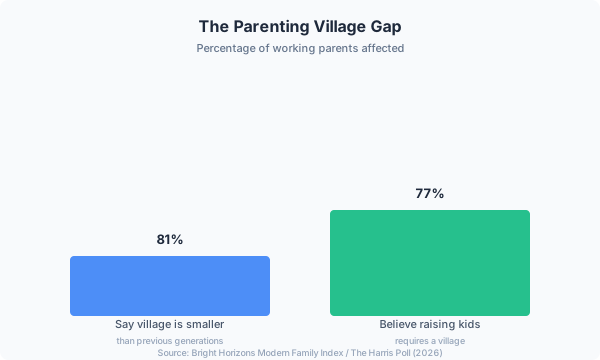
Source: Bright Horizons Modern Family Index / The Harris Poll (2026)
Why has the parenting village disappeared? Three structural shifts that stripped support
Federal Reserve data shows the problem plainly: 46% of parents with children under 13 use some form of unpaid childcare from someone other than a parent, yet 58% of those families rely on that help for fewer than 10 hours per week (SHED survey, 2024). The village that does exist covers a Tuesday afternoon pickup, not a full workweek.
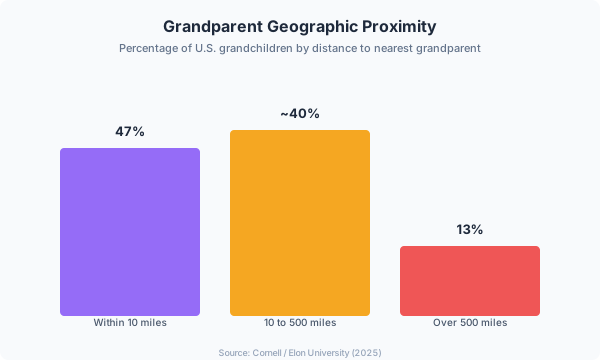
Grandparent proximity tells a similar story. A Cornell/Elon University study found a striking bimodal split: 47% of grandchildren live within 10 miles of a grandparent, while 13% live more than 500 miles away. You either have a grandparent nearby, or you really do not. And for families without nearby grandparents, the gap is hardening because Boston Fed research shows older adults are moving less than ever.
The consequences go beyond inconvenience. The U.S. Surgeon General's 2024 advisory, "Parents Under Pressure," declared parental stress a public health crisis. The numbers are sobering: 65% of parents report loneliness (versus 55% of non-parents), and 48% of parents experience completely overwhelming stress most days. Mothers have increased their work hours by 28% since 1985 while spending 40% more time on direct childcare. There is no slack left in the system.
A systematic review of over 1.2 million parents found that Western individualistic cultures show parental burnout rates five times higher than non-Western counterparts, even after controlling for economic factors. This is not about individual effort. The culture systematically dismantled the village, and the research shows what happens when you do that.
An Ohio State University survey puts it starkly: 38% of parents feel they have no one to support them. Yet 79% say they would value a way to connect with other parents. The desire is there. What is missing is the blueprint.

Sources: U.S. Surgeon General (2024), Ohio State University Survey
Step 1: Who is already around you? How to map your hidden village
Most parents drastically underestimate the potential support hiding in plain sight. Research from the Kids Help Phone community mapping framework shows that most people list just 1-2 people in their inner circle -- and that is completely normal. The problem is not that the people do not exist. It is that you have never formalized the relationship.
Grab a piece of paper or open a note on your phone and work through these categories:
- Neighbors with kids in the same age range. You wave at them. Your kids have played in the same yard. You have never once asked for help.
- School parents you recognize but do not call. The mom you always chat with at pickup. The dad who coaches your kid's soccer team.
- Coworkers who mention childcare stress. If they are stressed too, they are a potential swap partner, not just a sympathetic ear.
- Relatives within driving distance. Even if they can only do every other Friday.
- Local teens or college students. They need money or community service hours. You need an extra pair of hands on Wednesday afternoons.
- Community elders. Retired neighbors, church members, or adopted grandparents who might enjoy occasional involvement.
The Kids Help Phone community mapping framework uses concentric circles: your inner circle (people you could call tonight) and your outer circle (people who could become inner circle with a little relationship investment). If your inner circle has only one or two names, that is completely normal. As the framework notes, "It is not uncommon for people to have 1 or 2 people in their pod. This is not a popularity contest."
Citation capsule: Research consistently shows that people underestimate how willing others are to help. A Kids Help Phone community mapping framework uses concentric circles (inner: people you could call tonight; outer: potential with investment). Most parents list just 1-2 people in their inner circle. The key insight is that reciprocity -- offering help before asking for it -- turns acquaintances into village members.
For each name on your list, jot down two things: what they might be able to offer you and what you could offer them. That second column matters. As the parenting community resource Between Us Parents puts it, "Offer help to other parents first, maybe picking up their kid from school." Reciprocity is the engine.
Now for the awkward part: actually asking. Casually mention your summer childcare situation in conversation and see how the other parent responds. Try something like: "Have you figured out your summer coverage yet? I have been thinking about whether a few families could do a kid swap." That is not a direct ask. It is a temperature check. Research shows that people want to help more than you think, and the longer you sit and think about asking, the harder it gets. Do it anyway.
Step 2: Which childcare swap model fits your families? Carpool rotations, co-ops, and trades
One parent described saving thousands of dollars through a two-family childcare swap that provided 16 hours of free childcare per week. That is the scale of what is possible when families share care. The key is choosing the right structure for your situation.
Model 1: The carpool rotation
The simplest entry point. For two families, one handles morning dropoff, the other handles afternoon pickup. For three or more families, each household is assigned a specific weekday. SignUpGenius recommends creating a shared online signup sheet with automatic reminders and designating one parent as the schedule coordinator.
Rules that make carpools last:
- Only parents drive (no teen siblings, per Care.com safety guidance).
- Every child needs an appropriate car seat in every carpool vehicle. A proper child safety restraint reduces injury risk by 70%.
- Create an approved snack list and note allergies. Ban peanut products unless everyone confirms it is safe.
- Check your auto insurance. Most policies cover occasional carpool driving, but Care.com advises confirming it before the first ride.
Model 2: The babysitting co-op
A babysitting co-op is a group of families (typically 5 to 15) who trade childcare using a points or token system so nobody feels taken advantage of.
The Park Slope Parents model works like this:
- Start with about 8 families and one coordinator.
- Each family begins with 20 points.
- The exchange rate: 2 points per hour for one child, 3 points per hour for two children.
- When a member's balance drops to 15 points, they start babysitting to earn more. When someone accumulates 60 or more points, they are encouraged to spend them.
- If someone leaves the co-op, remaining points convert to $2 per point for a clean exit.
Track points with physical tokens (colored poker chips work beautifully, as one long-running co-op in Montana documented), a shared spreadsheet, or a dedicated platform like Babysitting Coop or Sitting Around (roughly $150 per year split among families).
The psychological shift is the real key. Claudia Davis, who ran a 12-family co-op for years, described it this way: "You were working with the group" rather than owing individual favors. That shift from one-on-one IOUs to a community credit system is what makes a co-op sustainable.
Model 3: The informal childcare swap
The simplest version for two families. One parent described saving thousands through a swap that provided 16 hours of free childcare per week per family: "I take your two on Tuesdays, you take mine on Thursdays."
Citation capsule: Informal childcare swaps between two families can provide up to 16 hours of free childcare per week per household. The critical design decision is choosing between a set schedule (more reliable) or as-needed exchange (more flexible). Most families find set schedules work better because reliability builds trust.
The critical design decision: choose between a set schedule (more reliable) or an as-needed exchange (more flexible). Most families find set schedules work better because reliability is the foundation of trust.
For all three models, the sustainability rules are the same:
- Have a backup plan for cancellations. Life happens. Decide in advance what the protocol is.
- Make it genuinely reciprocal. If family sizes differ, some groups calculate turns per child rather than per parent. Two kids means you take on duty twice as often.
- Keep the group manageable. A maximum of five families for informal swaps, up to 15 for structured co-ops.
- Double tickets for late pickups. This enforcement mechanism from Sweet Frugal Life avoids confrontation because the penalty is baked into the rules, not delivered as a personal reprimand.
Step 3: What communication system prevents chaos? Group chat, calendar, and caregiver info sheet
A University of Bath study (2024) found that mothers manage 71% of household mental load tasks, including 79% of recurring daily logistics. If your village depends on one parent being the central switchboard, you have not offloaded the work. You have just added a new inbox.
Set up your three-part infrastructure before summer starts:
1. A group chat for real-time coordination. A simple WhatsApp or iMessage group works. Use it for day-of logistics: "Running 10 minutes late for pickup." "Mia has a low-grade fever, keeping her home today." Keep it functional, not social. The group chat is a dispatch channel, not a meme thread.
2. A shared calendar for daily responsibility. Google Calendar is the most practical option. It is free, nearly everyone already has it, and you can create a dedicated Summer Childcare calendar shared without giving access to anyone's personal schedule. Color-code by family. If you want something purpose-built, Cozi takes under 10 minutes to set up. As one parent reviewer noted, it was the first app everyone in my house actually used.
The single most important rule: set it up before summer starts. As the Maple Blog puts it, "The app does not solve the problem. The habit does."
3. A shared document with everything a caregiver needs. This is the document that means no one texts you at 7 AM asking about your kid's allergies. Based on Care.com's caregiver guide, include:
- Parent mobile numbers and preferred contact method (text vs. call)
- Each child's pediatrician name and number
- All allergies (food, medical, environmental). As Care.com notes, this is "typically one of the first questions emergency responders will ask."
- Current medications with dosages and timing
- A backup emergency contact (nearby relative or neighbor)
- House rules: screen time limits, approved snacks, off-limits areas, bedtime routines
- Poison Control: 1-800-222-1222
Citation capsule: A University of Bath study (2024) found mothers manage 71% of household mental load tasks and 79% of daily logistics. To avoid concentrating this burden, set up three tools before summer: a group chat for day-of coordination, a shared calendar for responsibility tracking, and a caregiver info sheet with allergies, medications, emergency contacts, and house rules. The key rule: every caregiver can see the schedule without texting you first.
Pro tip from Chica and Jo: laminate the info sheet and use dry-erase markers for the parts that change (where you will be tonight, return time). Post it on the refrigerator.
If every caregiver in your rotation can see the schedule and the kids' info without texting you first, you have actually offloaded the work. If they cannot, you are still the switchboard.
Step 4: What ground rules prevent summer conflict? The 15-minute conversation
A peer-reviewed study of 353 mothers found that the proportion of mothers scoring in the clinically significant stress range was cut in half after joining a small peer support group. But support groups need ground rules to survive. This is the part most parents skip because it feels uncomfortable. Consider what happens three weeks into summer when you discover the neighbor lets your kids watch four hours of YouTube while you thought they were doing crafts.
Have one 15-minute conversation before summer starts. Not a contract. Not a legal document. Just a coffee-table chat covering the big five:
1. Screen time. Not everyone has the same rules, and that is okay. The goal is not identical policies but mutual understanding. Parenting researchers recommend starting with underlying values rather than specific rules: "What do we each want for the kids during these hours?" When strategies conflict, underlying needs rarely do.
2. Discipline approach. You do not need identical philosophies. You need to know each other's non-negotiables. The Sweet Frugal Life co-op guide recommends that the group collectively decides what methods are acceptable rather than one parent imposing rules.
3. Food rules and allergies. Share allergy information in writing, not just verbally. For severe food allergies, the Asthma and Allergy Foundation of America recommends a dedicated training session where caregivers practice using an auto-injector trainer and review emergency protocols.
4. Pickup, dropoff, and late penalties. Agree on specific times, a grace period, and consequences. The double-ticket penalty for late pickups works in co-ops. In informal swaps, a simple "text if you will be more than 10 minutes late" goes a long way.
5. What happens when things go sideways. A sick kid policy (the universal recommendation from every source: no sick kids, period), an emergency protocol, and a plan for when someone needs to cancel.
For the conversation itself, Parenting Journey's 3-step framework is the simplest approach that works:
- Communicate your need. "I have been thinking about how we handle screen time during swaps."
- Set the boundary. "For our family, we would like to keep screens off during the morning hours."
- Propose an alternative. "What if we did a 30-minute screen window after lunch instead?"
Boundaries are not barriers. As the Parenting Journey framework puts it, they are "one of the most loving things you can model for your children." Transparency prevents resentment. The awkward 15-minute conversation now saves three months of simmering frustration later.
Finally, schedule quarterly check-ins. HerMoney recommends a brief sit-down every three months to evaluate whether the arrangement is working and plan for upcoming schedule changes.
Citation capsule: A structured 15-minute conversation covering screen time, discipline, food allergies, pickup logistics, and sick kid policies prevents the most common sources of conflict in shared childcare. The Parenting Journey 3-step framework (communicate need, set boundary, propose alternative) gives parents a simple script. Schedule quarterly check-ins to keep the arrangement sustainable.
The village does not have to be perfect. It just has to exist.
According to the same Modern Family Index, 60% of American working parents are relying on a patchwork network of multiple caregivers: two neighbors, a college student, and your sister who can take the kids every other Friday. That patchwork is not a failure of planning. It is the honest reality for most families. And the research says it works.
A peer-reviewed study following 353 mothers found that 99.4% of participants recognized "I am not alone in the struggles I can face as a parent" after joining a small peer support group. Even mothers who attended fewer than seven sessions showed significant parenting stress improvements. The proportion scoring in the clinically significant stress range was cut in half.
What is the mechanism? Research in Frontiers in Psychology found that social support does not eliminate stressors. It changes how you perceive them. When you know someone has your back, even one person, the same stressor feels less overwhelming. There is no minimum threshold. Any support is better than none.
Recap the four steps you can start this week:
- Do the village audit. List every person in your orbit who could be part of your summer safety net. Include the people you have been too polite to ask.
- Pick one model and propose it. A carpool rotation, a childcare swap, or a co-op. Start with one conversation: "I have been thinking about whether a few families could share some summer coverage. Would you be open to that?"
- Set up the shared system. A group chat, a shared calendar, and a one-page caregiver info sheet on the fridge. Do this before the first week of summer, not during it.
- Have the ground rules conversation. Screen time, discipline, food, schedule, sick kids. Fifteen minutes. Coffee. Done.
Your village will not look like a Hallmark movie. It might be messy and small and held together by a group text and a laminated sheet on the fridge. That is enough. The point is moving from "I am doing this entirely alone" to "I have three people I can call."
Once your village is in place, keeping it running should not become its own full-time job. Tools like Nestify can help by giving every caregiver in your rotation shared visibility into the family calendar, tasks, and schedules, without anyone needing to be the central switchboard. Because you were never supposed to do this alone. And now, you do not have to.