
Key Takeaways
- Parents spend roughly 96 hours per year fighting about screen time, and 81% who set rules can't consistently enforce them (Pew Research Center, 2025)
- A dopamine menu organizes activities into effort-based categories (starters, mains, sides, desserts, specials), replacing "no screens" with "what sounds good?"
- Children who help build the menu show committed compliance, not surface-level obedience, because the rules feel like their own (Kochanska, 2001)
- Families report building their first menu in under 30 minutes with nothing more than paper, pens, and a Saturday morning
One number might make you feel less alone: American parents spend roughly 96 hours per year fighting with their children over screen time. That is four full days of conflict, every single year, just about whether a device gets put down (Talker Research/AngelQ, March 2025). Nine in ten parents report arguing with their kids about screens, and half say those fights erupt at least weekly (Talker Research/Aura, November 2025). If you are reading this during a 5 PM standoff while your kid melts down because you just said "no more iPad," you are not failing. You are living in a system that was never designed to work.
We found something that actually did work for our family. It is called a dopamine menu, and the reason it succeeds where screen-time limits fail is that it replaces "no" with "what else sounds good to you right now?" This article walks you through building one with your kids this weekend.
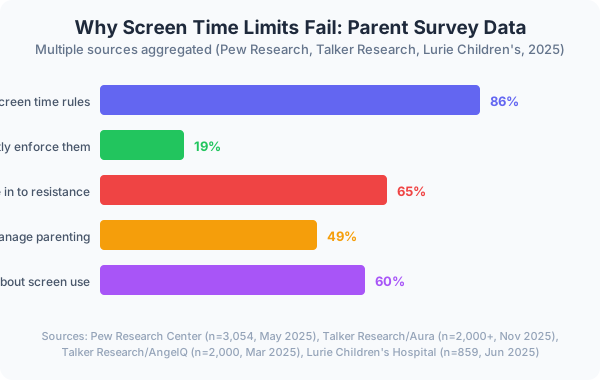
Multiple parent surveys from 2025 reveal the same pattern: knowledge is not the problem, execution is. (Sources: Pew Research, Talker Research, Aura, Lurie Children's Hospital)
Why Do Screen Time Limits Fail for Most Families?
Let's look at the data. Pew Research Center (October 2025) surveyed 3,054 parents and found that 86% have screen time rules. But only 19% consistently follow them. Think about that gap. Almost everyone sets the rules. Almost nobody can sustain them.
It is not because parents are weak. The whole approach is structurally flawed. A separate Talker Research survey found that parents give in to screen-time resistance 65% of the time. Gen Z parents surrender "often" at 28%. The arms race never ends.
"Restricting devices is more of a band-aid than solution." — Dr. Scott Kollins
The issue is biological, not moral. When you remove a screen from a child, you are removing their most accessible source of dopamine, the neurotransmitter responsible for pleasure, motivation, and reward-seeking. Without a replacement, you leave what researchers call a "dopamine vacuum." The behavioral results look like withdrawal: parents surveyed by AngelQ reported irritability (27%), mood swings (24%), tantrums (22%), and decreased focus (19%) after screen removal.
Pew Research participants put it plainly: restriction "paradoxically increases children's desire for devices." The more you squeeze, the more they want it. And you know what the numbers look like. Lurie Children's Hospital (2025) found that children under 13 average 21 hours of screen time per week, while parents say the ideal would be 9 hours. That 2.3x gap between intention and reality is not a willpower problem. It is a design problem. The dopamine menu is a design solution.
NPR coverage of Michaeleen Doucleff's book "Dopamine Kids" (March 2026), exploring how dopamine-driven devices affect children's behavior and what families can do about it.
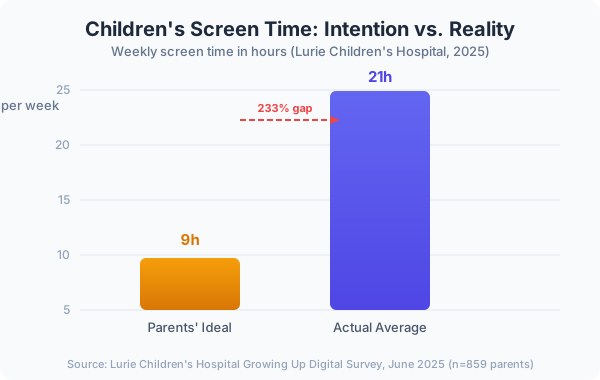
Children under 13 average 21 hours of screen time per week versus the 9 hours parents consider ideal. (Lurie Children's Hospital Growing Up Digital Survey, n=859, June 2025)
What Is a Dopamine Menu? How the Viral Concept Works in Real Families
The dopamine menu concept spread from ADHD self-help into 1 in 3 mainstream parenting discussions by early 2026, with NPR and multiple parenting publications covering the approach (NPR, March 2026). The term "dopa menu" was coined in May 2020 by Jessica McCabe of How to ADHD and Eric Tivers of ADHD reWired, originally designed for adults with ADHD who struggle with low baseline dopamine levels. The concept uses a restaurant metaphor to organize pleasurable activities by effort level and duration.
The categories are intuitive:
- Starters/Appetizers: Quick hits, under 15 minutes. A favorite song, a stretch, a doodle.
- Mains/Entrees: Sustained engagement, 30+ minutes. A bike ride, baking, building something.
- Sides: Paired with boring tasks to make them bearable. A podcast while tidying up.
- Desserts: High-dopamine activities prone to overuse. Social media, games, shows. Enjoyed in bounded portions.
- Specials: Rare, planned, bucket-filling adventures. A museum trip, a concert, a camping night.
As McCabe explains: "Just like it's hard to make really good food choices when you are already hungry, it's really hard to make good dopamine choices when you're already low on dopamine."
Jessica McCabe's original "Dopa Menu" video from How to ADHD (May 2020), where the concept was first introduced for adults with ADHD before families adapted it for screen-time management.
By 2025-2026, the concept spread from ADHD self-help into mainstream parenting. NPR covered Michaeleen Doucleff's book "Dopamine Kids" (March 2026). Parenting publications listed dopamine-aware parenting among their top trends for 2026. And unlike much wellness content on social media, experts actually endorse this one.
"Creating a dopamine menu or just a list of activities that spark joy for kids and the entire family is a great idea." — Dr. Arista Rayfield, Ph.D., Licensed Clinical Psychologist
What makes the menu different from a "boredom jar" or a list taped to the fridge? Two things. First, the categorization by effort level means kids can match their current energy to an activity. Too tired for a bike ride? Pick a starter. Second, the restaurant metaphor gives children the psychological frame of "ordering" rather than being told what to do. That shift from compliance to agency is everything.
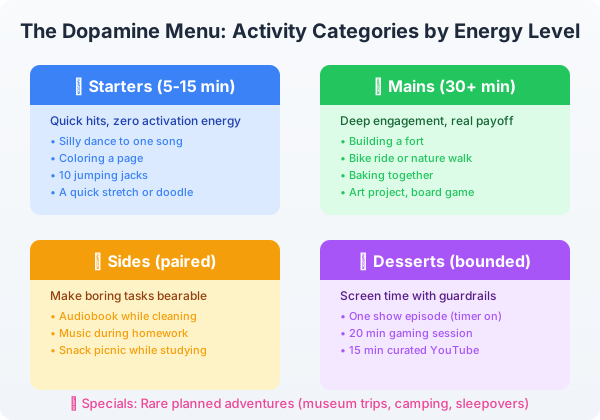
The dopamine menu organizes activities by effort level and duration so kids can match their energy to what they choose.
How to Build Your Family's Dopamine Menu Together
Research from a 2024 Seattle Children's study of 2,084 families (Kroshus-Havril, Steiner & Christakis) found that involving children in screen-time rule-making improved prosocial functioning across every age group, with the effect growing stronger as kids matured. This is the foundation of the dopamine menu: your kids must help build it. Not optional. Decades of developmental psychology back this up.
Researcher Grazyna Kochanska's landmark 2001 study, published in Developmental Psychology, followed families longitudinally and found that children show two types of rule-following. "Committed compliance" means genuine buy-in, where kids internalize rules and follow them even when nobody is watching. "Situational compliance" means going along because an adult is present. Only committed compliance leads to lasting behavior change. And committed compliance emerges when children embrace a framework as their own.
A 2024 study from Seattle Children's Research Institute (Kroshus-Havril, Steiner & Christakis) surveyed 2,084 families and found that involving children in screen-time rule-making improved prosocial functioning across all age groups. The effect grew stronger as kids matured. The conversation shifts from "I am telling you what to do" to "which thing that YOU chose sounds good right now?"
Gather everyone, set aside 30 minutes, and build this together:
Starters (under 15 minutes, zero activation energy):
- A silly dance to one song
- 10 jumping jacks or a cartwheel contest
- Coloring a single page
- Playing with playdough or slime
- A 5-minute Lego challenge
- Telling each other jokes
Mains (30+ minutes, real engagement):
- Building a fort with a movie night inside it later
- A bike ride or nature walk
- Baking cookies or making pizza dough
- An art project with real supplies
- A board game everyone picks together
- Writing and performing a short play
Sides (paired with boring tasks):
- An audiobook during room cleanup
- A favorite playlist during homework (if it helps, not hurts)
- A snack picnic while reviewing spelling words
Desserts (bounded screen time, with guardrails):
- One episode of a show with a visible timer
- 20 minutes of a favorite game
- 15 minutes of YouTube from a pre-selected playlist
The critical word is "bounded." Desserts are not forbidden. They are portioned. Set a timer. Put the device across the room when the timer goes off. Build friction between "dessert over" and "sneaking seconds."
Specials (rare, planned, something to look forward to):
- A trip to the science museum
- Backyard camping
- A sleepover with a friend
- Family movie night with homemade popcorn
Making It Stick: Where to Put the Menu and How to Use It Daily
A brilliant menu nobody sees is just decoration. Research from Vanderbilt's Center on the Social and Emotional Foundations for Early Learning (CSEFEL) shows that visual choice boards measurably reduce challenging behaviors and increase participation — in some studies by over 50% compared to verbal-only instructions. Visuals persist where verbal instructions vanish. Your child cannot remember six options you rattled off while making dinner. They can point to a poster on the fridge.
Where to display it:
- The refrigerator door. Classic, visible, works.
- A family command center or whiteboard with dry-erase markers so items rotate.
- A shared digital list in a family app everyone can see and update.
- For younger kids (ages 4-5): picture cards with drawings instead of text, 3-4 items per category.
When to reference it — the three critical transition moments:
Research shows children spend roughly one-third of their after-school time on screens (Haycraft et al., 2020). The transition from structured school to unstructured home creates what researchers call a "decision vacuum." The dopamine menu fills that vacuum.
Use it at these moments:
- After school (3-5 PM). Kids arrive depleted. Offer a snack first, then point to the menu. Dr. Jacqueline Sperling at Harvard Health recommends addressing hunger and tiredness before expecting cooperation.
- Before dinner (the "witching hour"). When everyone is restless and the easy move is to hand over a device while you cook.
- Weekend mornings. Unstructured plus alone plus home equals screen default.
When kids say "none of those are fun":
This will happen. It is not failure. Research from the University of Western Ontario (Kuczynski, Pitman & Twigger, 2019) studied children aged 9-13 and found that proposing alternatives is actually "the most skilful interpersonal strategy" and a sign of healthy autonomy development. A child rejecting the menu and suggesting something else means the system is working, not breaking.
Your protocol:
- Validate: "Got it, nothing on here is calling to you right now."
- Offer expansion: "What should we add for next time? Let's write it down."
- Hold the boundary gently: "You can pick something from the menu, or you can sit with this feeling for a bit. Both are okay."
Dr. James Danckert's research on boredom confirms that sitting with boredom becomes easier with practice. The menu is not obligated to eliminate boredom every single time. Updates happen during calm moments, not during meltdowns. If the menu needs refreshing, schedule a family revision session for the weekend.
Plan for boredom during calm moments, not during bored episodes.
Why Parents Need a Dopamine Menu Too
A 2024 study published in Pediatric Research found that parental screen time is "one of the strongest predictors of a child's screen time." A systematic review of 36 studies confirmed it: healthy parental media habits are the most crucial factor in reducing children's media exposure.
You cannot scroll your phone during the exact moments you are asking your kid to put screens away. Well, you can. But it won't work.
Pew Research focus group participants said it out loud: "Even we [parents] spend too much time on phones. How can we expect a 9-year-old to control and have a balance between their screen time?"
The dopamine menu solves this by making it a shared family culture rather than a top-down rule. Parents add their own items:
- Your starters: A 5-minute stretch, making tea mindfully, stepping outside for fresh air
- Your mains: Reading a chapter of your book, a short workout, calling a friend
- Your sides: A podcast while cooking dinner, music while folding laundry
- Your desserts: Your own bounded scroll time. Yes, you too.
When your kid says "I'm bored" and you say "let me check our menu too," you are modeling the behavior. When you announce "I'm picking a starter — I'm going to stretch for five minutes before I start cooking," you are showing them what intentional dopamine selection looks like.
This also solves another problem quietly: decision fatigue. A Harris Poll/Skylight survey (July 2024) found that parents spend 30.4 hours per week on parental mental load. Every time your child says "I'm bored" and you have to invent entertainment from scratch, that is another decision draining your already-depleted executive function. The menu eliminates that cognitive cost. You point. They choose. Nobody had to think of something new at 4:47 PM on a Wednesday.
Same principle as meal planning: one decision on Sunday eliminates seven decisions during the week.
Free Templates and Tools: Starting Your Dopamine Menu This Weekend
You do not need to design anything beautiful. You need a pen, some paper, and 30 minutes with your kids on Saturday morning. Copy this onto a sheet of paper:
| Category | Activity 1 | Activity 2 | Activity 3 | Activity 4 | Activity 5 |
|---|---|---|---|---|---|
| Starters (5-15 min) | |||||
| Mains (30+ min) | |||||
| Sides (with tasks) | |||||
| Desserts (with timer) | |||||
| Specials (plan ahead) |
Family Action UK offers a free printable PDF with both adult and child versions (family-action.org.uk), and ADDitude Magazine provides a downloadable template with pre-formatted categories.
Age-specific starter packs:
For a 4-5 year old, keep it simple. Three to four items per category, with pictures or drawings instead of words. Their starters: dancing to one song, blowing bubbles, playdough, building with blocks. Their mains: dress-up play, sandbox, water play, simple puzzles. Independent play at this age lasts 45-60 minutes, so set expectations accordingly.
For a 9-12 year old, go deeper. Six to eight items per category, text-based, and let them own the document. Their starters: shooting hoops, doodling, journaling, calling a friend. Their mains: creative projects, cooking a meal, reading, sports practice. They can handle 30-45 minute dessert windows with self-managed timers.
Format options:
- Physical: Laminated poster with dry-erase markers so items rotate. Magnetic board with moveable activity cards.
- Digital: A shared family list in an app that everyone can see and update from their own device.
- Hybrid: Physical on the fridge plus a photo in the family group chat for when you are out of the house.
The living document rule: This menu is not permanent. Kids grow. Interests shift. What thrills a 6-year-old in September bores them by January. Schedule a seasonal refresh every 2-3 months where the family asks: "What should we add? What should we remove? What have we not tried yet?"
The goal is simple. By the time you finish reading this, you have everything you need to sit down with your family this weekend and draft your first dopamine menu in under 30 minutes. No apps required. No perfection needed. Just a shared agreement about what "not screens" can look like, built by the people who will actually use it.
Because the best family systems are never the ones handed down from above. They are the ones everyone helped create.
This article was updated on June 7, 2026 with current research data. Created: May 17, 2026.